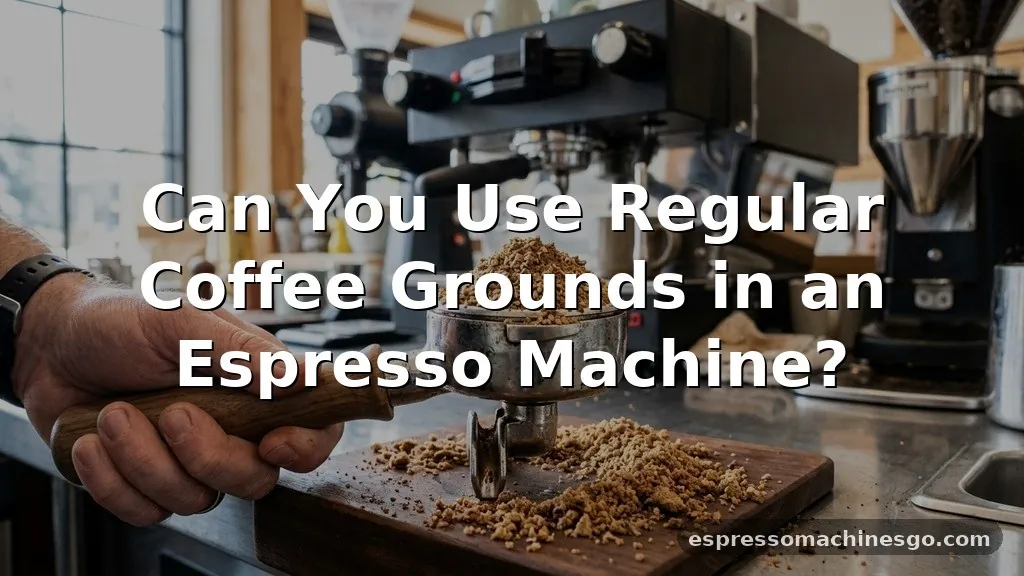
Many coffee enthusiasts frequently ask, can you use regular coffee grounds in an espresso machine? While it is physically possible to place standard drip-grind coffee into a portafilter, the resulting beverage often falls short of the rich, syrupy extraction characteristic of a true espresso. Understanding the science of extraction is essential for home baristas who want to elevate their morning routine.
The primary issue lies in the relationship between particle size, water pressure, and contact time. Because espresso machines are engineered to push hot water through a tightly packed puck of coffee at high pressure, the grind size must be calibrated specifically to create the necessary resistance for a balanced brew.
The Physics of Espresso Extraction and Grind Size
To understand why using regular coffee grounds in an espresso machine is problematic, we must first look at how these machines function. An espresso machine operates by forcing water through a compact bed of coffee at approximately nine bars of pressure. This extreme force is what emulsifies the coffee oils, creating the signature golden-brown crema.
The resistance required to generate this pressure is provided by the coffee grounds themselves. If the grounds are too coarse—which is typically the case with standard drip-grind coffee—the water flows through the puck far too quickly.
When the water moves through the coffee bed with little resistance, it fails to dissolve enough of the desirable soluble compounds. This leads to a cup that is thin, watery, and sour, lacking the body and complexity that define a quality espresso. The particle size for espresso is significantly finer than that used for a pour-over or an automatic drip coffee maker.
In fact, most espresso machines require a grind that feels like fine flour or talcum powder. Regular pre-ground coffee, usually sold in supermarkets for use in drip brewers, has a medium-coarse consistency. Using this in an espresso basket results in “channeling,” where the water finds the path of least resistance through the coarse grounds, leaving much of the coffee dry and unextracted.
The difference in grind size is not merely a preference; it is a fundamental requirement for the brewing process to work as intended. A professional-grade burr grinder is designed to produce a consistent particle distribution, which allows for uniform extraction.
Without this consistency, even if you manage to produce a liquid that resembles coffee, the chemical composition will be vastly different from a true espresso. You are essentially bypassing the mechanical design of the machine, which can lead to frustration when your shots consistently taste imbalanced or lack the syrupy mouthfeel you expect from a cafe-style drink.
Why Standard Pre-Ground Coffee Fails the Espresso Test
When you purchase coffee labeled as “drip” or “regular” grind, it has been processed to suit a brewing method where water sits in contact with the grounds for several minutes. This longer brewing time allows the water to extract flavors from larger particles.
Conversely, espresso brewing is a fast, high-pressure event, usually lasting between 25 and 30 seconds. If you use drip-ground coffee, the water passes through the puck in under 10 seconds, resulting in a weak, under-extracted mess.
Beyond the grind size, there is the matter of freshness and oxidation. Pre-ground coffee, regardless of the roast profile, begins to lose its volatile aromatic compounds the moment it is ground. By the time it reaches your home, much of the nuanced flavor profile has dissipated.
Espresso machines are unforgiving; they highlight the quality of the bean and the precision of the grind. Using stale, pre-ground coffee in a high-end machine is akin to putting low-octane fuel in a high-performance sports car. You will never achieve the best possible result because the input material lacks the necessary freshness and structural integrity for the machine to do its job properly.
Furthermore, many regular coffee blends are roasted specifically for drip brewing. These roasts might be too light or too dark, lacking the specific sugar development required for a balanced espresso shot. While you can technically use any coffee bean, the roast profile for espresso is often developed to be slightly more soluble, ensuring that the short contact time is sufficient to extract the sweetness and acidity needed to cut through milk.
The Role of Pressurized Baskets in Home Espresso Machines
Many entry-level espresso machines come equipped with what are known as “pressurized” or “dual-wall” filter baskets. These baskets are designed specifically for consumers who might use pre-ground coffee or who do not own a high-quality burr grinder.
Unlike standard baskets, which rely on the coffee puck to create resistance, a pressurized basket has a small pinhole at the bottom that restricts the flow of water. This mechanical restriction creates artificial back-pressure, allowing the machine to generate a crema-like foam even when using coarser grounds.
If you find yourself wondering if you can use regular coffee grounds in your specific espresso machine, check your filter basket. If your basket has a single hole at the bottom rather than a mesh screen, you are likely using a pressurized system.
In this scenario, using pre-ground coffee will yield a drinkable result. It will not have the same clarity of flavor as a shot pulled from a professional machine with a non-pressurized basket, but it will certainly be more palatable than what you would get if you tried to pull a shot with coarse grounds in a commercial-grade machine.
However, even with a pressurized basket, you are limited by the quality of the coffee itself. The pressure mechanism cannot compensate for the lack of fresh grounds or improper roast profiles.
It is a helpful tool for beginners, but it acts as a crutch rather than a solution for true espresso extraction. As you progress in your coffee journey, you will likely find that transitioning to a dedicated espresso grinder and non-pressurized baskets is the most effective way to unlock the true potential of your beans.
Comparing Brewing Methods and Grind Requirements
To visualize why grind size is the most critical variable when using an espresso machine, it is helpful to look at how different brewing methods compare. Every method requires a specific particle size to achieve the ideal contact time between water and coffee.
| Brewing Method | Grind Size | Contact Time | Pressure |
|---|---|---|---|
| Espresso | Extra Fine | 25-30 Seconds | 9 Bars |
| Moka Pot | Fine/Medium-Fine | 3-5 Minutes | 1.5 Bars |
| Drip Coffee | Medium | 5-8 Minutes | Gravity |
| French Press | Coarse | 4 Minutes | Gravity |
As shown in the table, the relationship between pressure and grind size is inverse. High-pressure methods like espresso require a very fine grind to create resistance. Low-pressure methods like French press require a coarse grind to prevent over-extraction and bitterness.
When you attempt to use regular drip coffee in an espresso machine, you are essentially trying to force a “Medium” grind into an “Extra Fine” slot. The machine’s pump will struggle to build pressure, and the water will effectively bypass the coffee, resulting in a thin, sour beverage that misses the mark entirely.
Addressing Topical Gaps: Can You Modify Regular Grounds?
A common question is whether you can modify regular coffee grounds to make them suitable for espresso. While you cannot “re-grind” coffee in a standard blade grinder—which would only create an uneven, dusty mess—there are a few techniques that home enthusiasts often try to bridge the gap. Some people attempt to use a mortar and pestle to further crush pre-ground coffee, but this is labor-intensive and rarely produces the uniform particle size required for a consistent extraction.
The most effective way to “modify” your brewing approach if you only have regular coffee is to adjust your technique. If you have a machine with a pressurized basket, you can increase your dose slightly to fill the basket completely, ensuring that the coffee is tamped down firmly.
Tamping creates a denser puck, which can help increase the resistance even if the grind size is not ideal. However, do not over-tamp, as this can lead to other issues like channelling or the machine struggling to push water through entirely.
Another approach is to focus on the water temperature. Espresso is typically brewed between 195 and 205 degrees Fahrenheit. Because regular coffee is usually roasted for drip brewing, it may be more soluble.
Lowering your water temperature slightly can sometimes help prevent the extraction of harsh, bitter compounds that often appear when using coffee that wasn’t designed for high-pressure brewing. It is important to remember that these are workarounds, not solutions.
The most significant improvement in your espresso will always come from using fresh, whole-bean coffee ground immediately before brewing. You can learn more about the science of coffee extraction from the National Coffee Association, which provides detailed insights into the variables that affect your daily cup.
Practical Tips for Better Espresso at Home
If you are committed to using an espresso machine, investing in a high-quality burr grinder is the single most impactful upgrade you can make. A burr grinder ensures that every particle of coffee is the same size, which is the secret to a balanced, sweet, and rich shot.
When you control the grind, you control the extraction. You can adjust the size to make the shot run slower or faster, allowing you to “dial in” the perfect flavor profile for your specific coffee beans.
Here are several tips to improve your espresso experience:
- Always use fresh-roasted coffee beans, ideally within two to four weeks of the roast date.
- Invest in a scale to weigh your coffee dose; consistency is the key to repeatable results.
- Ensure your espresso machine is properly warmed up before you pull a shot, as cold components will drop the water temperature.
- Clean your portafilter and basket after every use to prevent the buildup of stale oils, which can impart a rancid taste.
- Experiment with the water-to-coffee ratio; a common starting point is a 1:2 ratio (e.g., 18 grams of ground coffee producing 36 grams of liquid espresso).
- Use filtered water to protect your machine from scale buildup and to ensure that the flavor of your coffee remains pure and clean.
By following these practices, you move away from the limitations of using pre-ground coffee and start to engage with the craft of espresso making. Every bean used has a unique flavor profile, and by controlling the variables, you can highlight the chocolatey, fruity, or nutty notes that the roaster intended. Achieving a café-quality shot at home is a rewarding challenge that requires patience and a willingness to learn how the different components of your machine interact with your coffee.
FAQ: Common Espresso Questions
Can I use regular pre-ground coffee in a non-pressurized basket?
Technically, yes, but it is not recommended. Because the grind is too coarse, the water will flow through the basket instantly, resulting in a thin, sour, and watery shot with almost no crema. It will not taste like true espresso.
How do I know if my espresso machine has a pressurized basket?
Look at the underside of your filter basket. If it has a single, tiny hole in the center, it is a pressurized basket. If it has a fine mesh screen that covers the entire bottom, it is a non-pressurized, professional-style basket.
Will using regular coffee grounds damage my espresso machine?
It is unlikely to damage the mechanical components of the machine, but it can lead to clogging if the grounds are too fine or if they contain debris. The biggest risk is not mechanical failure, but rather the frustration of consistently poor-tasting shots that waste your coffee.
What is the most important factor for good espresso?
Freshness and grind consistency are the most important factors. Using high-quality, freshly roasted coffee beans and grinding them immediately before brewing with a burr grinder will provide the most significant improvement to the flavor, body, and overall quality of your espresso shots.