
Many home baristas wonder if they can simply use their favorite bag of grocery store beans in their high-end equipment. The short answer is that while you physically can put regular coffee in an espresso machine, the results are rarely what you expect.
Understanding the technical nuances of brewing is essential to protecting your equipment and ensuring the flavor of your morning cup is actually palatable. When you ask, “can you put regular coffee in an espresso machine,” you are really asking about the compatibility between grind size, pressure, and chemical extraction.
The Fundamental Role of Grind Size
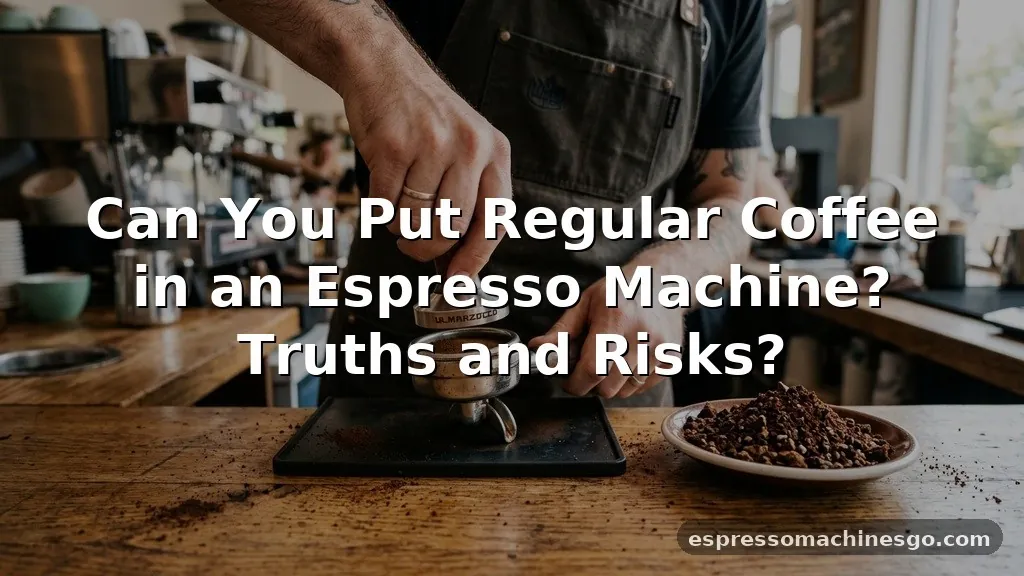
The primary reason why standard grocery store coffee often fails in an espresso maker comes down to the physical particle size. Espresso requires a very fine, powdery consistency that allows water to pass through under immense resistance. If you use coffee grounds intended for a standard drip coffee maker, you are using particles that are significantly larger and coarser.
When you pack these coarse grounds into an espresso portafilter, the water encounters very little resistance. Instead of the slow, syrupy drip characteristic of a perfect shot, the water will rush through the puck in a matter of seconds.
This process is known as channeling, where water finds the path of least resistance, resulting in an under-extracted, sour, and watery beverage that lacks the body and complexity of true espresso. Achieving the correct grind is not just about taste; it is about creating the necessary back-pressure that allows the machine to function as intended.
Pressure and Extraction Dynamics
An espresso machine is engineered to force hot water through a compacted puck of coffee at roughly nine bars of atmospheric pressure. This specific level of pressure is the engine behind the emulsification of coffee oils, which creates the signature golden-brown foam known as crema. When you use regular coffee—which is typically ground for immersion or gravity-fed brewing—the machine cannot build the required pressure.
Without that resistance, the extraction process is fundamentally altered. Espresso is designed to be a concentrated extraction of soluble solids and aromatic oils. If the grounds are too coarse, the water passes through too quickly to pull out these essential compounds.
You end up with a drink that has none of the viscosity or intense depth associated with a real espresso. Furthermore, if you attempt to force the machine to compensate by overdosing the portafilter, you risk damaging the group head gasket or straining the internal pump, which is designed to push against a specific level of resistance.
Roast Profiles and Flavor Expectations
The roast level of your beans plays a massive role in how they perform under pressure. While many people assume that espresso beans are a different species of plant, they are actually just coffee beans that have been roasted according to specific profiles. Often, these beans are developed to be darker to balance the high-pressure extraction process, which can highlight bitterness if not managed correctly.
In contrast, lighter roast coffees, which are frequently sold as “regular” coffee, contain higher levels of acidity and delicate floral or fruity notes. When these are subjected to the intense heat and pressure of an espresso machine, those subtle notes can be obliterated or turned into unpleasant, sharp, or metallic flavors.
If you decide to experiment with regular beans, you must be prepared for the fact that the difference between these roasts will be magnified. A bright, acidic light roast might taste vibrant in a pour-over, but turn into a harsh, astringent experience when forced through an espresso portafilter.
Comparing Brewing Methods
To understand why your machine reacts differently to various inputs, it helps to look at the mechanical requirements of each method. The following table illustrates the stark differences in how these two common brewing styles handle the same raw material.
| Feature | Espresso Brewing | Drip/Regular Brewing |
|---|---|---|
| Grind Size | Extra Fine (Powdery) | Medium to Coarse |
| Pressure | 9 Bars (High) | Atmospheric (Low) |
| Brew Time | 25 to 30 Seconds | 3 to 5 Minutes |
| Water Ratio | High Concentration | High Dilution |
As you can see, the parameters are almost opposites. Using a normal drip-grind coffee in an espresso machine is akin to trying to drive a sports car through a muddy field; the machinery is built for a precision environment, and throwing in variables it wasn’t designed for will inevitably lead to a performance drop-off.
Topical Gaps: Is It Dangerous for the Machine?
A common concern among home users is whether using the wrong grind or bean type will actually “break” the machine. While a single attempt is unlikely to cause a catastrophic failure, repeated use of improper coffee grounds can lead to long-term wear. The most significant risk is the clogging of the shower screen and the solenoid valve.
When coffee is ground too finely for a drip machine, it isn’t an issue, but when coffee is ground too coarsely for espresso, tiny “fines” (microscopic dust particles) can migrate through the portafilter basket. These particles can bypass the filter and end up in the machine’s internal plumbing.
Over time, these fine particulates accumulate, leading to reduced water flow, inconsistent pressure, and eventually, a total blockage that requires professional maintenance. You can read more about the technical aspects of coffee brewing to better understand how particle size affects the flow rate and the health of your brewing equipment.
How to Adapt if You Must Use Regular Coffee
If you find yourself in a situation where you only have regular, pre-ground coffee and you absolutely must use your espresso machine, there are a few adjustments you can make to mitigate the disaster. First, do not try to tamp the coffee as hard as you would with a proper espresso grind. Since the particles are larger, you need the water to move through them, but you still need some resistance.
* Increase the dose slightly to fill the basket more densely.
* Use a slightly cooler water temperature to avoid over-extracting the already porous grounds.
* Keep your expectations low; you are essentially making a concentrated, slightly muddy version of a long black or an Americano.
* Clean your group head thoroughly after the session to ensure no loose grounds remain in the machine.
Even with these tweaks, you will likely notice that the brew lacks the characteristic crema. Without the fine grind, the carbon dioxide trapped in the beans is never properly emulsified into the water. Instead of a thick, persistent layer of foam, you might see a thin, bubbly, or non-existent layer that dissipates almost immediately after the shot is pulled.
The Value of Freshness and Proper Equipment
Ultimately, the quality of your coffee depends on the freshness of the bean. Espresso machines are unforgiving. If you use stale, pre-ground coffee, the oils have already oxidized, and the volatile aromatic compounds have evaporated.
This is why most enthusiasts invest in a high-quality burr grinder. By grinding your own beans immediately before brewing, you preserve the volatile oils that give espresso its body and intensity.
When you use fresh beans, you have control over the grind size, allowing you to “dial in” the shot. If the shot runs too fast, you adjust your grinder finer; if it drips too slowly, you adjust it coarser. This level of control is impossible with pre-ground “regular” coffee, which has a fixed particle size that you cannot change.
If you are committed to the craft of espresso, the grinder is arguably more important than the machine itself. Without the ability to manipulate the particle size, you are essentially flying blind, hoping that the coffee you bought happens to be the perfect size for your specific basket and pump pressure.
FAQ Section
What happens if I put regular drip coffee grounds in my espresso machine?
The water will flow through the loose grounds far too quickly because the grind size is too coarse for the machine’s pressure. This results in a weak, sour, and watery shot that lacks the thick, golden crema characteristic of a true espresso.
Can I use pre-ground coffee meant for espresso in a regular drip maker?
Technically yes, but it is not recommended. The fine grounds will likely clog the paper filter, leading to an extremely slow brew time and a bitter, over-extracted cup. It may also cause the water to overflow the filter basket, creating a mess in your kitchen.
Is there a way to make espresso without an actual espresso machine?
Yes, you can use a Moka pot or an AeroPress. While these do not generate the nine bars of pressure required for “true” espresso, they produce a concentrated, strong cup of coffee that serves as an excellent base for milk-based drinks like lattes or cappuccinos.
Why do my shots taste bitter when using fresh beans?
Bitterness is often a sign of over-extraction. This happens if the water is too hot, the grind is too fine, or the contact time between water and coffee is too long. Try coarsening your grind slightly or reducing the total brew time to balance the flavor profile.