

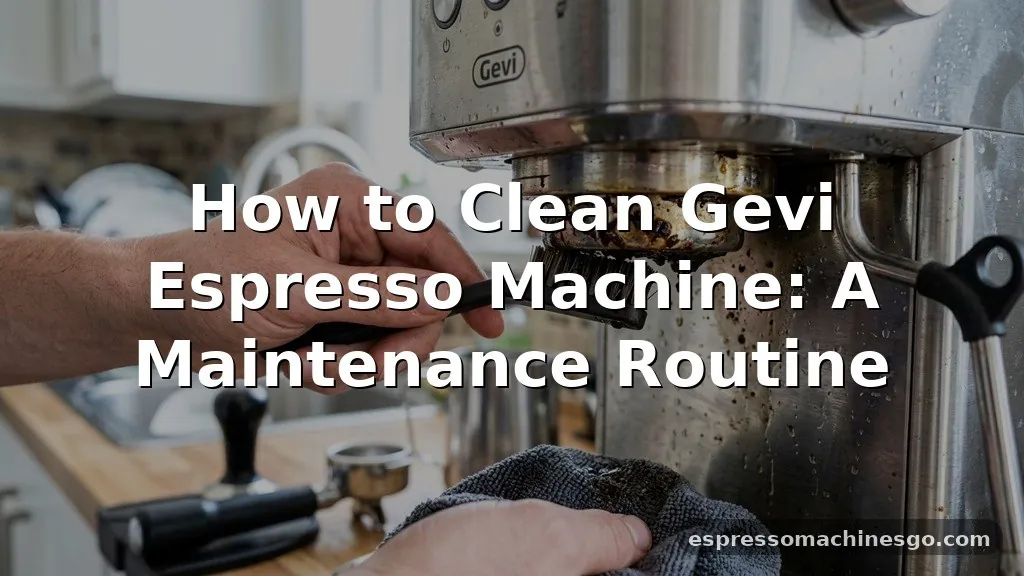
Maintaining your coffee hardware is the single most effective way to ensure that every shot of espresso you pull tastes as rich and balanced as the day you unboxed the device. If you are learning how to clean Gevi espresso machine components, you are likely noticing that your coffee has started to taste bitter or that the flow rate of the water has slowed down significantly.
These are classic indicators that mineral buildup and coffee oils have begun to compromise the internal pathways of your machine. By establishing a consistent maintenance schedule, you prevent these residues from hardening into permanent obstructions, ultimately extending the lifespan of your appliance and preserving the integrity of your daily brew.
The Importance of Regular Maintenance for Espresso Quality
The primary reason for a thorough clean is the accumulation of organic compounds. Every time you brew, microscopic coffee particles and essential oils coat the group head, the portafilter, and the internal tubing.
Over time, these residues oxidize, turning rancid and imparting a sour, metallic, or burnt profile to your fresh beans. When you learn how to clean Gevi espresso machine parts properly, you aren’t just sanitizing the device; you are protecting the flavor profile of your favorite roast.
Beyond the flavor, there is the technical performance of the maker. Modern espresso machines rely on precision pumps and fine mesh screens to maintain the correct pressure for extraction. If you ignore the regular accumulation of scale—which occurs naturally due to the minerals present in your tap water—the pathways eventually narrow.
This leads to uneven extraction, where the water finds the path of least resistance rather than saturating the coffee grounds evenly. Consistent care ensures that the pressure remains stable and the thermal stability of the boiler is not compromised by lime deposits.
Identifying the Signs Your Machine Needs Descaling
How do you know when it is time to move beyond a simple rinse and perform a deep descaler procedure? The machine itself will often provide subtle cues.
If you notice that the drip speed of your espresso has decreased or the pump sounds significantly louder or more strained than usual, the internal boiler is likely coated in calcification. Another common sign is inconsistent water temperature; mineral deposits act as an insulator, preventing the heating element from transferring heat efficiently to the water.
If you live in an area with hard water, you should anticipate needing to perform this process more frequently. Hard water is rich in calcium and magnesium, both of which are the primary culprits behind stubborn mineral buildup. Even if you use a water filter, trace elements will eventually collect.
You should aim to check the condition of your machine every two to three months, or sooner if you observe white, chalky flakes appearing in your brewed coffee. Ignoring these signs can lead to the heating element failing entirely, which is often a non-repairable fault in compact home machines.
Preparing the Right Cleaning Solution
When considering the solution to use, you have two primary paths: commercial-grade descaling agents or natural alternatives. Many users ask if they can use vinegar, as it is a common household staple.
While white vinegar is an effective acid for dissolving lime, it can be difficult to rinse out completely, and the lingering odor can affect the taste of your coffee for several subsequent brews. If you choose to use a vinegar mix, ensure you perform multiple rinse cycles with fresh water to clear the acidic residue.
For the best results, look for a citric acid-based powder or a pre-formulated liquid descaler designed specifically for espresso equipment. These are designed to be food-safe and easy to flush from the system.
Always refer to the official National Coffee Association guidelines on equipment maintenance if you are unsure about the specific chemical compatibility of your machine’s gaskets and seals. Using an overly harsh chemical can degrade the rubber o-rings that prevent leaks, so stick to products formulated for coffee makers.
Step-by-Step Guide to Descaling the System
To begin the process, ensure the machine is powered off and the water tank is empty. Remove any existing water filter cartridges, as these can trap the descaling agent and become damaged.
Fill the water reservoir with your prepared solution—if using a powder, ensure it is completely dissolved before adding it to the tank. Place a large container under the group head and the steam wand to catch the discharge.
Follow these steps for a deep clean:
- Power on the machine and allow it to reach operating temperature.
- Run about half of the solution through the group head by engaging the brew switch.
- Run the remaining half through the steam wand to ensure the internal steam valve is also cleared of buildup.
- Turn the machine off and allow the solution to sit in the boiler for 15 to 20 minutes; this dwell time is essential for breaking down stubborn deposits.
- After the dwell time, run several full tanks of fresh, clean water through the machine to completely flush out the cleaning agent.
Cleaning the Portafilter and Group Head
The group head and portafilter are the areas most exposed to coffee oils. These oils are hydrophobic and will stick to metal surfaces even after a rinse.
To clean these, remove the filter basket from the portafilter and soak both in a mixture of hot water and a specialized coffee detergent. If you do not have a dedicated detergent, a very mild dish soap can work, provided you rinse it with extreme care to avoid soapy flavors in your future espresso.
Use a stiff-bristled brush to scrub the group head screen. You will often find coffee grounds lodged in the perimeter of the screen, which can cause channeling during the brewing process.
If your Gevi model has a removable screen, take it off once a month to clear out the debris that accumulates behind it. This is a common topical gap in many maintenance manuals, as users often assume the backflushing process is enough to clear the screen, but physical scrubbing is far more effective.
Data Comparison: Maintenance Frequency for Optimal Performance
To maintain your equipment, you must understand the relationship between water hardness and maintenance intervals. The following table outlines the recommended frequency for descaling based on the quality of your water supply.
| Water Hardness Level | Descaling Frequency | Recommended Action |
|---|---|---|
| Soft Water (Filtered) | Every 6 Months | Standard rinse and wipe |
| Moderate Hardness | Every 3 Months | Full descaling cycle |
| Hard Water (Tap) | Every 4-6 Weeks | Full descaling + filter change |
Addressing Common Troubleshooting Issues
If you find that your machine is still not performing correctly after a thorough clean, check the pump intake. Sometimes, air bubbles can get trapped in the lines during the cleaning process.
This is known as an airlock. To fix this, you can try priming the pump by running the steam wand while the machine is on, which forces the air out of the system and allows the water to flow freely again.
Another issue involves the steam wand tip. If the steam pressure is weak, it is likely that dried milk has clogged the small holes in the nozzle. Use a thin needle or a specialized steam wand cleaning tool to clear these holes.
Never use a toothpick, as it can snap off and leave wood fibers inside the nozzle, which will cause a permanent blockage. Always wipe the wand with a damp cloth immediately after every use to prevent milk from hardening in the first place.
Frequently Asked Questions
How often should I descale my Gevi espresso machine?
If you use filtered or bottled water, you should aim to descale every three to six months. If your local water supply is particularly hard, you should increase this frequency to once a month to prevent significant mineral buildup from damaging your internal heating components.
Can I use vinegar to clean my coffee machine?
While vinegar is a common household acid, it is not recommended for most espresso machines because it is difficult to rinse out completely. The lingering acidic smell and taste can ruin your coffee for days. It is better to use a dedicated, food-grade descaling powder.
What is the best way to clean the steam wand?
The best method is to purge the wand with steam immediately after frothing milk. Then, wipe the exterior with a damp cloth. If milk becomes stuck, soak the tip in hot water and use a small needle or cleaning tool to clear the nozzle holes manually.
Why is my espresso machine leaking water?
Leaks are often caused by a worn-out group head gasket. Over time, the heat and pressure cause the rubber to harden and crack. Regular cleaning prevents coffee grounds from building up around this seal, which can otherwise cause the gasket to fail prematurely and result in leaks.