
Many coffee enthusiasts find themselves staring at a bag of standard drip-brew grounds while their espresso machine sits idle, wondering if they can bridge the gap between these two brewing worlds. The short answer is that yes, you technically can use regular coffee in an espresso machine, but the experience is rarely satisfying and can potentially harm your equipment.
While the machine will physically process the water through the grounds, the result is often a thin, sour, or overly bitter beverage that lacks the signature body and crema of a true espresso. Understanding why this happens requires looking at the science of extraction, particle size, and the specific pressure requirements of high-end brewing technology.
The Mechanics of Extraction and Why Grind Size Matters

To understand why standard coffee struggles in an espresso machine, you must first recognize the fundamental difference in how these machines extract flavor. An espresso machine relies on high pressure—typically nine bars—to force hot water through a tightly packed “puck” of finely ground coffee.
The grind size for espresso is extremely fine, often described as having the consistency of powdered sugar or fine table salt. This fine texture creates significant resistance against the water, forcing the machine to work to push the liquid through, which in turn emulsifies the coffee oils into that rich, golden crema we associate with a perfect shot.
In contrast, regular coffee—intended for drip machines, French presses, or pour-overs—is ground significantly coarser. When you put these coarser grounds into an espresso portafilter, the water passes through them with almost no resistance.
Because the water encounters so little friction, it flows through the puck in seconds rather than the ideal 25 to 30-second window. The water does not have enough contact time with the coffee particles to dissolve the necessary solids, leading to a weak, watery, and acidic drink that fails to capture the complex flavor profile the bean was intended to express.
Technical Risks to Your Espresso Equipment
Beyond the poor quality of the beverage, using the wrong grind can introduce mechanical issues that might shorten the lifespan of your machine. Espresso machines are precision instruments engineered to handle a specific amount of resistance.
When you use coffee ground for a drip machine, the lack of resistance can sometimes cause the pump to over-pressurize or behave erratically. Conversely, if you attempt to “compensate” by over-packing or tamping the regular grounds too hard, you risk creating a blockage that puts unnecessary strain on the solenoid valve and the group head gasket.
Furthermore, many commercial or high-end home machines have sensitive internal components that are not designed to handle the debris or uneven particle distribution found in standard pre-ground coffee. If the grounds are too inconsistent, small fines might bypass the filter basket and enter the machine’s internal piping.
Over time, this can lead to clogs in the dispersion screen or even damage the pump’s seals. While this is unlikely to break a machine after a single use, it is a bad habit to form if you want your expensive equipment to remain in peak condition for years to come.
Comparing Espresso and Drip Coffee Specifications
To visualize why these two methods are fundamentally incompatible, it helps to look at the differences in how the coffee is processed and prepared. The following table highlights the key technical differences that prevent standard grounds from working well in an espresso environment.
| Feature | Espresso Preparation | Drip/Regular Preparation |
|---|---|---|
| Grind Consistency | Ultra-fine (Powdery) | Medium to Coarse (Sandy) |
| Pressure Used | High (9 bars) | Low (Gravity/Atmospheric) |
| Extraction Time | 25–30 Seconds | 3–5 Minutes |
| Crema Production | High (Emulsified Oils) | None |
As indicated in the table, the extraction time is perhaps the most critical variable. By trying to force a 3-minute extraction process into a 30-second window, you are essentially short-circuiting the chemical process that makes coffee taste balanced. Without the fine grind to slow the water down, you are essentially just rinsing the coffee beans rather than brewing them.
Can You Adjust Your Technique to Make It Work?
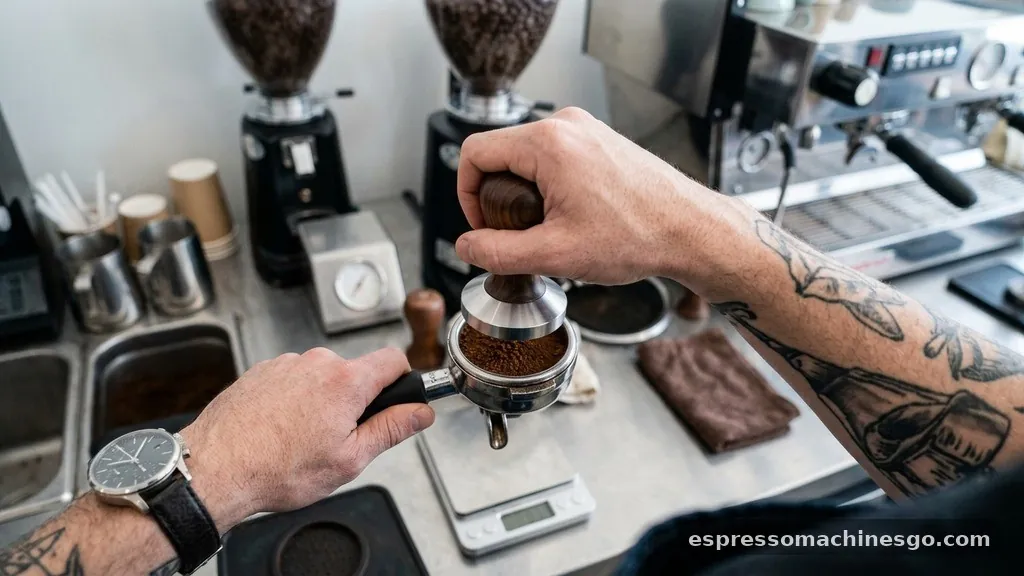
If you find yourself in a pinch and absolutely must use regular coffee, there are a few adjustments you can make to mitigate the poor results, though you should not expect a cafe-quality shot. First, increase the dose of coffee in your portafilter basket.
Because the grounds are coarser, you need more physical volume to create enough resistance to slow the water down. A slightly larger dose can help simulate the pressure buildup that a finer grind would naturally provide.
Second, utilize a firmer tamp than you normally would. While you should never over-exert yourself, applying more pressure can help pack the larger particles tighter, creating a denser barrier for the water to navigate. However, be aware that even with these adjustments, you will likely encounter “channeling.”
Channeling occurs when water finds the path of least resistance through the coffee puck, leading to uneven extraction where some parts of the coffee are over-extracted and bitter, while others are under-extracted and sour. You can learn more about the science of coffee brewing from the National Coffee Association, which provides comprehensive insights into the various methods of preparation.
Topical Gaps: Addressing Common Misconceptions
Many users search for whether they can “turn” regular coffee into espresso. It is important to clarify that espresso is a method, not a specific bean. Any coffee bean can technically be used to make espresso, provided it is roasted and ground correctly.
The common misconception is that “espresso roast” is a different species of coffee; in reality, it is simply a roast profile designed to be more soluble and forgiving under high pressure. If you have a bag of light roast drip coffee, you can absolutely use it in an espresso machine, provided you have a high-quality burr grinder that can reach the necessary fineness.
Another gap in common knowledge involves the use of pre-ground coffee from the grocery store. People often ask if they can use “espresso-labeled” pre-ground coffee. While this is ground finer than standard drip coffee, it is often still too coarse for professional-grade machines.
It is designed for pressurized portafilter baskets, which are common in entry-level home machines. If you are using a commercial-style machine with a non-pressurized basket, even store-bought “espresso” grounds will likely yield a thin, crema-less shot. The key takeaway here is that the equipment you own dictates the grind requirement, not the label on the bag.
Best Practices for Consistent Results
If you are committed to the hobby of pulling espresso, the most important investment you can make is a dedicated grinder. Having the ability to dial in your grind size to the micron is what separates a frustrating morning of watery coffee from a rewarding cafe experience. When you grind your own beans, you ensure that the coffee oils are fresh and that the particle size is perfectly uniform, which is the secret to achieving that thick, syrupy consistency.
* Always prioritize fresh beans roasted within the last two to four weeks.
* Use a burr grinder rather than a blade grinder to ensure uniform particle size.
* Keep your espresso machine clean to prevent old oils from tainting your shots.
* Experiment with your dose weight using a digital scale to achieve consistency.
* Adjust your grind size slightly based on the ambient humidity of your kitchen.
By following these practices, you eliminate the need to rely on pre-ground coffee altogether. The process of making espresso is a balance of art and science, and while it is tempting to look for shortcuts, the quality of your result will always be tied to the precision of your preparation. If you treat your machine with respect and use the appropriate grind for the pressure it generates, you will find that the process becomes much more predictable and the final cup significantly more enjoyable.
FAQ Section
What happens if I use regular ground coffee in my espresso machine?
If you use regular drip-ground coffee, the water will flow through the portafilter too quickly because the grounds are too coarse to create resistance. The result is a thin, watery, and sour-tasting shot that lacks the rich crema and body of a properly prepared espresso.
Can I adjust my machine to handle regular coffee grounds?
You can attempt to increase the dose of coffee or tamp more firmly to create more resistance, but this rarely produces a high-quality result. It may also lead to uneven extraction, known as channeling, which creates a bitter and unpleasant flavor profile in the final cup.
Will using regular coffee damage my espresso machine?
Using regular coffee occasionally is unlikely to cause immediate damage, but it is not recommended. The lack of proper resistance can cause erratic pump behavior, and the inconsistent size of regular grounds may clog the dispersion screen or internal valves over time, potentially leading to maintenance issues.
Is “espresso-labeled” pre-ground coffee better than regular coffee?
Yes, it is ground finer than standard drip coffee, making it slightly better suited for espresso machines. However, it is often optimized for pressurized portafilter baskets. If you use a professional-grade machine with a non-pressurized basket, you will still likely struggle to achieve a high-quality, authentic espresso shot.